
The annals of Hindi cinema are replete with legends, yet few command the reverence bestowed upon Guru Dutt. Despite directing a mere eight films in his tragically short 39-year life, his name invariably features among the pantheon of India’s greatest filmmakers. Today marks the birth anniversary of this visionary director, actor, and producer, whose cinematic masterpieces have been endlessly debated and celebrated. However, beyond the silver screen, Dutt’s personal life was as intricate and compelling as any of his narratives – a tapestry woven with marital discord, professional shifts, and the profound solitude of a creative soul. On this day, it is pertinent to reflect upon the tumultuous personal journey of Guru Dutt.
The man behind the camera was a complex figure, his existence inextricably linked with personal struggles, marital strain, creative angst, and a pervasive loneliness. Central to these complexities was his turbulent relationship with his wife, the legendary playback singer Geeta Dutt, and the enduring whispers surrounding his association with actress Waheeda Rehman, which continue to captivate audiences and biographers alike.
Their story began in the nascent years of the 1950s, a period when Geeta Dutt, then Geeta Roy, was already a luminary in Hindi cinema. Her melodious voice captivated millions, making her one of the industry’s most sought-after vocalists. In stark contrast, Guru Dutt was a struggling director, striving to carve out his niche. Fate intervened during a film project, where their professional acquaintance blossomed into a deep affection. They were individuals from vastly different spheres – one an established artist, the other an ambitious young director with dreams in his eyes. Despite facing numerous societal and familial obstacles, their bond deepened.
At the time, their professional standing was poles apart. Geeta was the primary breadwinner for her family, her popularity and earnings enviable. Guru Dutt, conversely, was still fighting to establish his career. This stark imbalance would later fuel much speculation and tension within their relationship, laying the groundwork for future challenges.
After a courtship spanning three years, marriage finally ensued. Securing the approval of both families proved arduous, particularly from Geeta’s side, who were reluctant for her to marry prematurely given her significant financial responsibilities towards them. Eventually, following several years of perseverance, they wed. Initially, their domestic life appeared idyllic, blessed with the arrival of two children. Yet, beneath the surface of apparent normalcy, a gradual estrangement began to take root, largely attributable to the changing tides of fortune.
Post-marriage, Guru Dutt’s career ascended with remarkable speed. One acclaimed film after another cemented his status as a pivotal filmmaker in the nation. His artistic vision, particularly in films like ‘Pyaasa’ and ‘Kaagaz Ke Phool’, resonated deeply, securing his place in cinematic history.
Concurrently, Geeta’s illustrious singing career began to wane. The emergence of new vocal talents, the evolving landscape of musical trends, and the burgeoning pressures of her personal life all contributed to a reduction in her professional engagements. Where once Geeta had been the more established figure, their positions gradually reversed. This professional paradigm shift, many biographers contend, profoundly impacted their personal relationship, adding another layer of complexity to their marital fabric.
Those who knew Guru Dutt intimately often described him as an introverted, sensitive, and utterly dedicated individual, consumed by his craft. Hours were spent meticulously contemplating every facet of filmmaking – from scripting and editing to lighting and shot composition. Cinema was his paramount sanctuary, an escape from the mundane and the deeply personal.
This intense artistic absorption often isolated Guru Dutt from his family life. While his family yearned for a conventional domestic existence, Guru Dutt seemed increasingly lost within the intricate worlds of his own creation, a common lament among the spouses of creative geniuses.
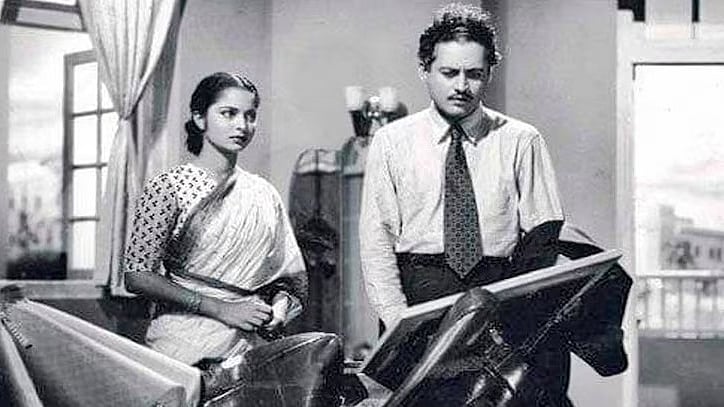
It was during this period that the young actress Waheeda Rehman began to feature prominently in Guru Dutt’s films. Her innate talent, captivating screen presence, and naturalistic performances profoundly impressed him. She was cast in significant roles in successive productions, and it was not long before whispers concerning their professional relationship began circulating within the film fraternity. While concrete evidence of a romantic entanglement never publicly emerged, numerous memoirs, interviews, and biographies from that era confirm that these rumours had a palpable and detrimental effect on Guru Dutt’s marriage.
These reports inevitably reached Geeta Dutt, sowing seeds of doubt, resentment, and further deepening the chasm between them. The intricate triangle of love, art, and fame ultimately spiralled into a profound personal catastrophe, leading to domestic strife, professional struggles, and a sequence of events that remain one of the most debated chapters in Indian cinematic history.
The fissures in Guru Dutt and Geeta Dutt’s marriage cannot be solely attributed to a ‘third person’, a simplistic narrative that history often discredits. Instead, their relationship crisis stemmed from a confluence of factors: the relentless pressures of work and burgeoning success, fundamental differences in temperament, and the incessant industry gossip. In the late 1950s, Guru Dutt and Waheeda Rehman collaborated on a string of successful films. Her presence in ‘CID’, ‘Pyaasa’, ‘Kaagaz Ke Phool’, and ‘Chaudhvin Ka Chand’ captivated audiences. Simultaneously, stories of their growing closeness became rife within the film circles. Although neither party publicly acknowledged a romantic relationship, the whispers persisted.

Biographers have noted that this situation took a significant toll on Geeta Dutt’s mental well-being. She frequently questioned acquaintances about her husband’s suspected liaison, while many attempted to reassure her that these were mere rumours. However, when gossip gains daily momentum, it inflicts wounds as real as any tangible truth.
Some memoirs even recount an incident where Geeta Dutt allegedly resorted to a fabricated love letter to test her husband’s loyalty. This reportedly enraged Guru Dutt. Abrar Alvi, a close associate, claimed in his memoirs that Guru Dutt confessed to having, in a fit of anger, physically assaulted his wife after this incident. This account is primarily based on memoirs and biographies, lacking independent contemporary verification, and is therefore considered a contentious claim within historical discourse.
The turbulence in Geeta Dutt’s personal life inevitably began to cast a shadow over her professional career. Her distinctive voice, once an indispensable element of Hindi cinema, became increasingly less heard. Various explanations exist for this decline. Some attribute it to the arrival of a new generation of singers, diminishing her opportunities. Others suggest that the strain of her domestic life pulled her away from her work. Certain biographies claim Guru Dutt preferred her to sing primarily for his own productions, a point on which historians remain divided.
Compounding these issues, financial difficulties began to mount. Some family investments failed, leaving Geeta, who had long been the family’s primary earner, facing an uncertain future.
In a poignant attempt to breathe new life into their fractured relationship, Guru Dutt conceived a Bengali film titled ‘Gauri’. He chose Geeta Dutt as his leading lady, despite her primary identity as a singer. However, deep-seated disagreements surfaced almost immediately upon the commencement of filming. Memoirs describe a heated exchange on set concerning her make-up and preparation. In a moment of intense frustration, Geeta Dutt reportedly invoked Waheeda Rehman’s name, asking, “Do you want me to look worse than Waheeda?”
A stunned silence descended upon the set. Filming ceased abruptly, and the project was ultimately abandoned, a poignant symbol of their irreconcilable differences. Guru Dutt subsequently turned his attention to other ventures, but the emotional chasm within their marriage remained unbridgeable. From this point, their personal lives seemed to diverge onto two parallel paths: Guru Dutt’s creative struggle as a world-class filmmaker, and the gradual fading of an extraordinary vocalist’s star.

Despite the profound marital strain, Guru Dutt and Geeta Dutt did, at one juncture, attempt to salvage their relationship. Biographies and memoirs indicate that Guru Dutt sought to distance himself from Waheeda Rehman and return to his family. For a brief period, they spent time together once more, and another child was born into the family. However, this reconciliation proved fleeting and unsustainable.
Family recollections reveal Guru Dutt as intensely creative yet profoundly introverted. He immersed himself for days on end in the worlds of shooting, editing, and scriptwriting, displaying a clear disinterest in social gatherings or family events. Geeta Dutt, conversely, was vivacious, gregarious, and enjoyed social interaction. This fundamental disparity in their personalities, many believe, further widened the gulf between them.
In October 1964, at the tender age of 39, Guru Dutt’s untimely death sent shockwaves through the Indian film industry. While numerous conjectures surround his demise, official records attribute it to an overdose of sleeping pills combined with alcohol. Whether it was an accident or an act of suicide remains an unanswered question to this day.
The profound impact of Guru Dutt’s death weighed most heavily upon Geeta Dutt. According to family accounts, she suffered a prolonged period of mental breakdown. Despite her desire to return to work, she could not rediscover her former self. Concurrently, Geeta Dutt’s physical health deteriorated, exacerbated by excessive alcohol consumption leading to severe liver complications. In 1972, at just 41 years old, Geeta Dutt also passed away. Within a span of merely eight years, Indian music and cinema lost an extraordinary artistic couple, leaving behind a legacy as brilliant as it was tragic.
Throughout the swirling rumours concerning Guru Dutt, Waheeda Rehman consistently maintained a dignified silence. In various interviews, she acknowledged Guru Dutt as one of the most significant directors of her career, yet she rarely spoke publicly about their personal relationship, preserving a sense of decorum amidst the swirling controversies.